Water in landscapes

Naturem Solutions contributes to improving water management at territorial and watershed scale, from catchment areas (agricultural, forest and natural watersheds) to valley bottoms (river renaturation). This approach is inspired, among other things, by the principles of regenerative hydrology and low-tech process-based restoration of riverscapes.
Restoring the natural water cycle

Land development and human activities and practices have an impact on the water cycle and on the condition of watercourses. These phenomena can increase runoff and erosion, reduce aquifer recharge, cause flooding through overflow, increase irrigation needs, lead to pollution of water bodies, river straightening and channel incision, and reduce biodiversity.
A regenerative approach to territorial water management, involving adaptation of practices at plot scale, makes it possible to restore the natural water cycle (retention, evaporation, infiltration, etc.). Further downstream, low-tech infrastructure inspired by natural processes enable watercourses to reconnect with their floodplains and gradually regain a “free” flow regime, with all the collateral benefits.

Our approach to territorial water management
We propose to study/assess impacts and support you in implementing developments at plot or watershed scale that allow natural processes, mainly linked to water-soil-plant interactions, to restart.
We also support you in defining and constructing low-tech structures for rivers.

Preliminary diagnosis of the watershed or stream
The territory and watershed are diagnosed, taking account of existing human uses and activities. Hydrological calculations are performed to characterise flows according to selected rainfall events, and existing water pathways are identified.
For watercourses, the baseline assessment identifies key points for attention: biological condition and species to protect (where applicable), risks or opportunities associated with the floodplain, the most appropriate sections, etc.
Selection and design of landscape structures
Based on the first stage and integrating agricultural practices (soil conservation, etc.), we propose and size developments and structures at plot or territorial scale. These include tree and hedge planting (including agroforestry), grassland areas and revegetation, excavation of different types of ponds, retention areas, wetlands and tall-herb communities, as well as arrangements designed to slow water pathways between them. The importance of living and functional soil is not overlooked, and water quality is also taken into account, especially for applications involving protection of drinking water abstraction areas (focus on water resource protection).
The study also includes an assessment of the impact of these nature-based solutions against the objectives, whether they relate to flood and erosion control, water quality, water resources or resilience to climate change.
Low-tech process-based restoration of riverscapes
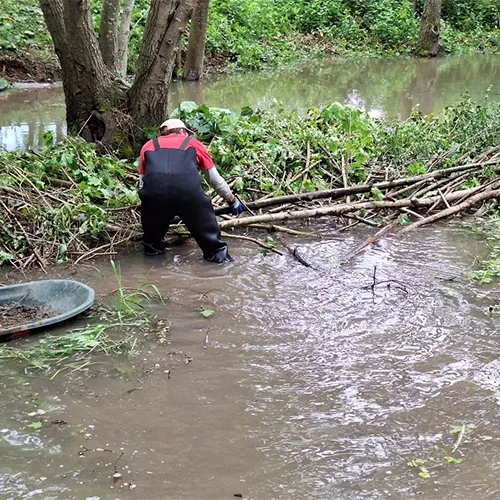
In addition to defining the objectives (renaturation, meandering, reconnection to the floodplain, etc.), the size, number and type of low-tech structures to be implemented (beaver-dam analogues or wood structures), our contribution consists of supporting the client in organising the worksite (which may be participatory) and its implementation, as needed, while limiting impacts linked to temporary disturbance of the environment.
In line with process-based principles, the river does the work afterwards ! Nevertheless, we stayed involved and help you to monitor the impact against the objectives, which is always recommended.
Sustainable nature-based solutions
Why implement regenerative water management at plot or watershed scale?

Increase territorial resilience
This objective concerns public administration companies, drinking-water producers, water resource and watercourse managers or major landowners, with the aim of reducing the risk of flooding through overflow or mudflows, securing water resources and the quality of water bodies, promoting adaptation to climate change or simply ensuring resilient spatial planning, while helping to improve biodiversity.

Restore natural water cycles
Any farmer, forester or natura site manager has an interest in restoring natural water cycles on to benefit from the many opportunities arising from a regenerative “sponge landscape”.

Restore water streams
A watercourse with a more natural flow regime provides greater resilience in terms of downstream flood risk, water storage in the soil, water quality (sedimentation, etc.) and habitat variability (temperature, depth, etc.) favourable to biodiversity. This is achieved at a much lower financial cost and with a much lower environmental footprint than projects involving earthworks and infrastructure, which is a clear benefit in programmes such as flood risk management plans (FRMPs), river basin management plans (RBMPs) or the application of the European Nature Restoration Regulation.
Naturem Solutions, your sustainable water management expert

Multidisciplinary expertise
Naturem Solutions has proven expertise and experience in water management. Our multidisciplinary team, working with partners and external experts, can respond to your needs in various fields and provide appropriate solutions.

Complete project support
Our team does not simply propose theoretical solutions. It supports you throughout your project. We also ensure that each proposal is adapted to the specific features and requirements of the site.

Commitment to resilience
Our approach is based, among other things, on the principles of regenerative hydrology and low-tech process-based restoration of riverscapes, while taking account of human uses and activities to improve their resilience.
In need of an expert in regenerative water management?